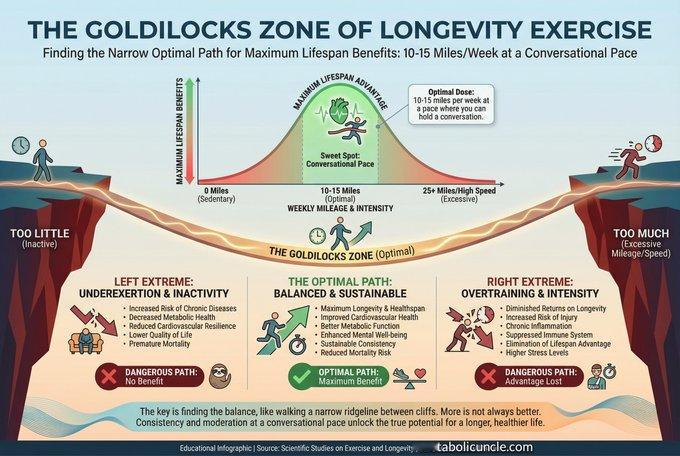
为什么马拉松训练会缩短你的寿命你的心脏并非为承受长期的折磨而生。让你忍受更长时间痛苦的心血管压力,也会使你变得更加脆弱。运动能拯救生命,这一点毋庸置疑。但长期高强度训练却会产生一个悖论:资深耐力运动员的冠状动脉钙化程度更高,房颤发生率是久坐人群的五倍,而且心肌瘢痕通常见于心脏病患者。其机制很简单。在持续剧烈运动时,心脏泵血量会达到静息状态的五到六倍。60分钟后,这种机械性负荷会超过身体的适应能力。肾上腺素飙升,自由基积聚,心肌组织出现微小撕裂。这样做一次,就能愈合;如果每周都这样做,持续数年,就会形成疤痕组织。对马拉松完赛者的研究表明,超过半数的完赛者肌钙蛋白水平升高,这是一种心脏损伤标志物,心脏病专家认为它与心脏病发作有关。这些肌钙蛋白是由机械应力造成的微小撕裂。反复的机械应力会导致心腔扩张、心壁增厚和永久性纤维化。数据清晰地表明,一项对52000名跑步者进行长达30年追踪的研究发现,每周以舒适配速跑5到20英里的跑步者比不跑步的人寿命长19%。而每周跑量超过25英里或配速超过7.5英里/小时的跑步者,其寿命优势则完全消失。每周七天跑步甚至完全抵消了长寿带来的好处。哥本哈根的一项独立研究发现,适度慢跑者比久坐不动的对照组寿命长六年,但过度运动者并没有表现出优势。这种关系与饮酒类似,死亡率曲线呈U形,过量饮酒和过量饮酒都会增加风险。在跑步机测试中,最佳体能水平出现在时速约为 7 至 7.5 英里(11 至 12 公里)时。超过这个阈值后,进一步的心血管训练并不能带来额外的降低死亡率的益处。高原是真实存在的。马拉松运动员的尸检结果显示,他们的心脏肥大且有瘢痕。一位传奇的超级马拉松运动员在一次例行的12英里(约19公里)跑步中猝死,享年50岁。尸检结果显示,他患有特发性心肌病,很可能是数十年高强度训练累积造成的损伤。明尼苏达州的一项研究发现,尽管传统风险因素较轻,但参加马拉松比赛 25 年的老将冠状动脉斑块比久坐不动的对照组高出 62%。动物实验带来了希望。小鼠连续四个月每天跑步至精疲力竭,结果出现了同样的心脏病变。停止训练后,心脏恢复正常,纤维化逆转,电不稳定性也得到解决。建议很简单:每天尽可能多地步行。每周进行两到五天,每次15到40分钟的跑步或其他剧烈运动,速度以轻松交谈的速度(大约每英里10分钟)进行。短时间内达到峰值心率是可以的,但持续在第四或第五心率区间进行高强度运动则不合适。人类进化是为了适应间歇性的高强度运动和恢复。持久狩猎需要的是耐力,而不是速度。现代的耐力文化误把痛苦当作进步。你的心脏需要的是脉动式的压力,需要运动后真正的休息,而不是持续的炎症。适度运动者寿命最长。不是久坐不动的人,也不是铁人三项全能选手。而是每天活动,偶尔进行高强度运动,然后适时恢复的人。将步行、轻松的第二区活动(游泳、骑自行车、跑步、划船)与重复的冲刺间歇训练结合起来,就能达到最佳效果。你不需要忍受痛苦或学会忍耐疼痛才能保持健康。你也不需要追求超过45分钟的最大摄氧量才能长寿。Why Marathon Training is Shortening Your LifeYour heart isn't built for chronic punishment. The same cardiovascular stress that makes you endure pain and suffering for longer can also make you vulnerable.Exercise saves lives. That's undisputed. But chronic high-intensity training creates a paradox: veteran endurance athletes show elevated coronary calcification, atrial fibrillation rates five times higher than sedentary people, and myocardial scarring typically seen in cardiac patients.The mechanism is straightforward. During sustained hard efforts, your heart pumps five to six times its resting volume. After 60 minutes, this mechanical stretch overwhelms adaptation capacity. Adrenaline spikes, free radicals accumulate, and microscopic tears appear in cardiac tissue. Do this once, it heals. Do this weekly for years, scar tissue accumulates.Studies of marathoners completing races show over half have elevated troponin levels, a cardiac injury marker cardiologists associate with heart attacks. These are micro-tears from mechanical stress. Repeat exposure causes chamber dilation, wall thickening, and permanent fibrosis.The data is clear. A 52,000-person study tracked runners for 30 years. Runners who covered 5 to 20 miles weekly at a comfortable pace lived 19% longer than non-runners. Those exceeding 25 miles weekly or running faster than 7.5 mph pace saw benefits disappear entirely. Running seven days per week eliminated longevity gains.A separate Copenhagen study found moderate joggers lived six years longer than sedentary controls, but extreme exercisers showed no advantage. The relationship mirrors alcohol consumption, a U-shaped mortality curve where both extremes increase risk.Peak fitness on a treadmill test occurs around 7 to 7.5 mph. Beyond that threshold, further cardiovascular conditioning provides no additional mortality benefit. The plateau is real.Marathoner autopsies reveal enlarged, scarred hearts. One legendary ultrarunner died at 50 during a routine 12-mile run. His autopsy showed idiopathic cardiomyopathy, likely accumulated damage from decades of extreme training.A Minnesota study found 25-year marathon veterans had 62% more coronary plaque than sedentary controls despite better traditional risk factors.Animal studies offer hope. Mice run to exhaustion daily for four months developed the same cardiac pathology. When training stopped, hearts normalized. Fibrosis reversed. Electrical instability resolved.The prescription is simple. Walk daily, as much as possible. Run or perform vigorous exercise 15 to 40 minutes, two to five days weekly, at a conversational pace around 10-minute miles. Your peak heart rate during brief intervals is fine. Sustained Zone 4 or 5 efforts are not.Humans evolved for intermittent intensity followed by recovery. Persistence hunting required stamina, not speed. Modern endurance culture mistakes suffering for progress. Your heart needs pulsatile stress, work followed by genuine rest, not perpetual inflammation.The moderate exerciser lives longest. Not the sedentary person, not the Ironman finisher. The person who moves daily and occasionally pushes hard, then backs off.Combine walking, easy zone 2 activities (swimming, biking, running, rowing) with repeated sprint interval training and you are doing the optimum.You don't need to suffer or learn to sustain pain to be fit. You don't need to aim for a VO2 max beyond 45 to live long.